![New_Centercode_Logo.png]](https://help.centercode.com/hs-fs/hubfs/New_Centercode_Logo.png?height=35&name=New_Centercode_Logo.png)
Project Overview Dashboard
This dashboard summarizes every aspect of your project in one easy-to-access and easily shared place. Everything from the health of your project, to your top feedback and Ted’s performance (if he’s enabled). Your project introduction is also displayed here and is controlled via your project template settings.
To open the Project Overview, select Management > Dashboards > Project Overview.
Delta Health and Success

This dashboard element displays the overall Delta health and success scores for your project, which are defined as:
Delta Health: Health is a measurement of engagement from your testers. A low letter grade means that either your testers didn't complete their assigned activities, submit actionable feedback, or both. This score is critical to ensuring predictability for the success of your product.Delta Success: Success is a prediction of how successful this product will be in the eyes of your tester audience, based on the sentiment of the impact and type of feedback they provide. Success begins as a range and is represented as a whole number once health reaches an A+, ensuring a confident prediction.Delta Impact: Impact measures the effectiveness of your test by comparing the difference between your success prediction without feedback addressed (i.e. if your product had gone to market without this test) versus your success score based on the feedback you successfully addressed (i.e. your product now).
How Delta Health is calculated
Delta Health measures whether your participants are doing the work your test plan asks for. It's made of two equal halves: how much of the expected activity has been completed, and how much of the expected feedback has come in.
Both goals scale with the size of your test. They're based on two numbers:
- Features. The active features in your active Engagement phases, plus regression features when a phase includes regression.
- Target number of testers. The participant target you set in your project settings.
The activity goal is one completed activity per feature for each targeted tester. The feedback goal is one piece of feedback for every five features, per targeted tester. Each half stops counting once its goal is met, so a flood of feedback can't make up for activities nobody has completed.
The formula
For anyone who wants the arithmetic:
- Activity goal = Features × Target number of testers
- Feedback goal = 0.2 × Features × Target number of testers, rounded down to a whole number
- Activity contribution = the lower of (Completed activities ÷ Activity goal) and 1, × 50
- Feedback contribution = the lower of (Feedback created ÷ Feedback goal) and 1, × 50
- Health = Activity contribution + Feedback contribution, out of 100
Phase health
Phase Health uses the same calculation with only that phase's features counted. The target number of testers is always the project-level target, even inside a phase.
The dashboard doesn't show a phase's goal as a number. Hover over a health score to see its breakdown: the score out of 100, the percent from the activity goal, and the percent from the feedback goal. The project's participant progress shows in the dashboard title bar as "X of Y (Z%) of participant target."
Notes
- A health score shows as N/A until there's enough feedback or engagement to measure.
- Raising the target number of testers raises both goals, so your health score drops until participation catches up.
How Delta Success is calculated
Delta Success does not read your feedback text. It is built entirely from structured signals you already control: what kind of feedback each item is, what its status says about how it was handled, and how much impact it carries.
Three things feed the score:
- Feedback type intent. Whether an item is an Issue, an Idea, or Praise.
- Status intent. Whether an item has been resolved, and whether it has been excluded. See Declaring intent behind your feedback status.
- Impact Score. Each item's weight and popularity, which decides how much it counts. See the Guide to feedback impact scoring.
Every item contributes its impact to one of four buckets: outstanding Issues, outstanding Ideas, Praise, and Ideas you have implemented. Praise and implemented Ideas push the score up. Outstanding Issues pull it down. Outstanding Ideas sit in the middle, counting toward the total without helping or hurting, so a pile of unaddressed suggestions pulls the score toward the midpoint rather than sinking it.
Because the calculation uses impact rather than item counts, one high-impact Issue moves the score more than several minor ones. Resolving an Issue removes its impact from the outstanding bucket, which is why the score responds to triage work rather than to feedback volume.
The formula
For anyone who wants the arithmetic, each bucket's share is taken as a percentage of total impact across all four buckets, and the score is:
Success = (100 + ((Praise% + ImplementedIdea%) - OutstandingIssue%)) / 2
The result is a 0 to 100 figure. A project with no impact recorded yet scores 0. Centercode also keeps the same calculation run against your feedback before any fixes were applied, and the difference between the two is your Delta Impact.
Notes
- Delta Success shows as a range rather than a single number until your project's Health score reaches 65. Below that there is not enough signal for the prediction to be meaningful, and it may show as not available.
- Feedback you have excluded does not count toward any bucket.
- Because status intent drives half the calculation, projects that do not keep statuses current will see a score that lags the real state of the test.
Activity Engagement and Feedback Impact

Displays the number of activity engagements (including activity completions, blocks, opt-outs, and views), average activity satisfaction score, and total feedback impact generated by each feedback type.
Project Phase Schedule
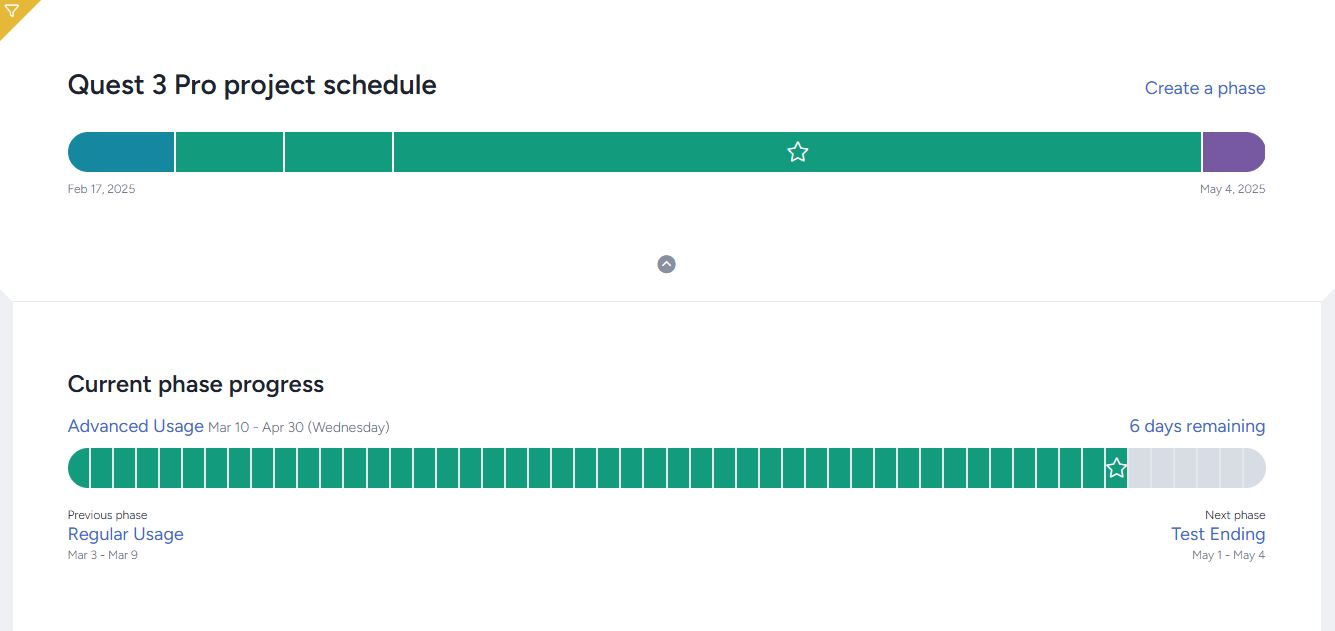
Displays the overall project phase progress, as well as information on the progress of the current phase.
Feedback Type Overview
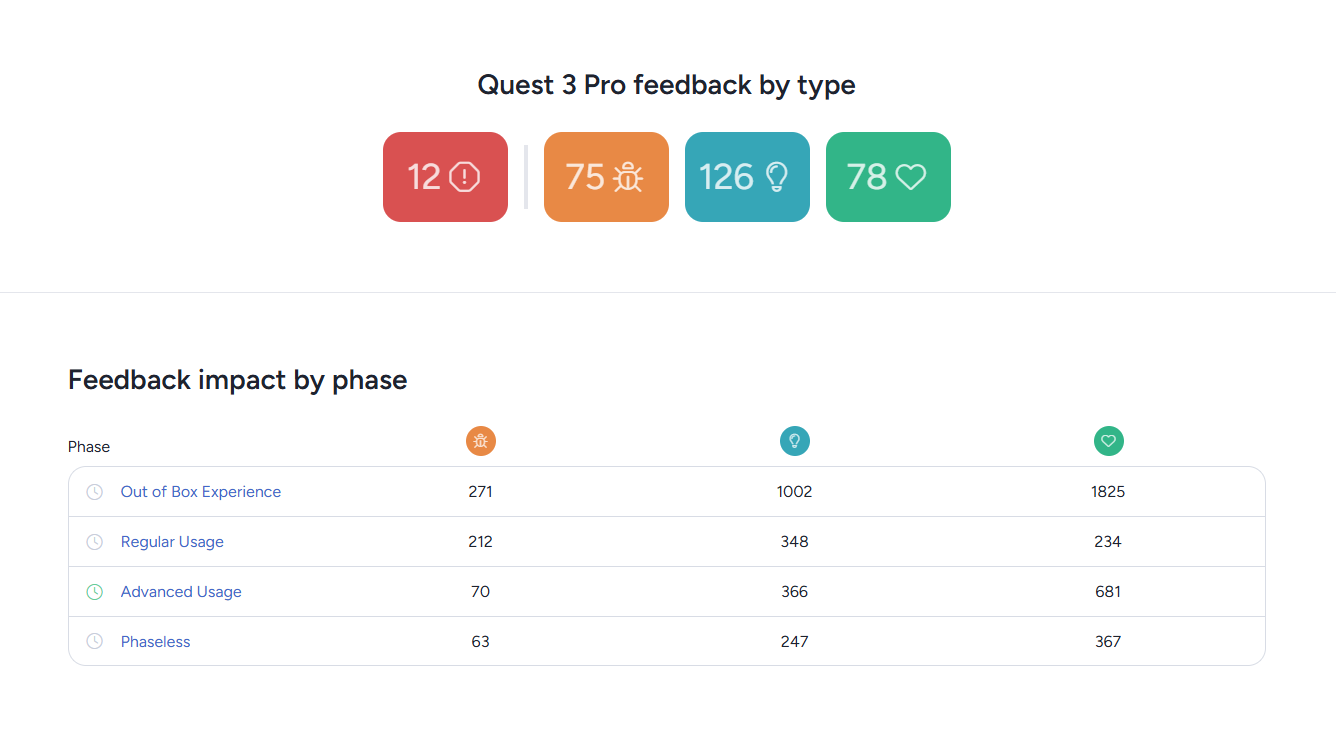
Displays information related to your various feedback types, including overall number of feedback submitted of each type, number "blocking" issues submitted, and the amount of feedback impact generated for each feedback type in each phase.
Project Audience Metrics
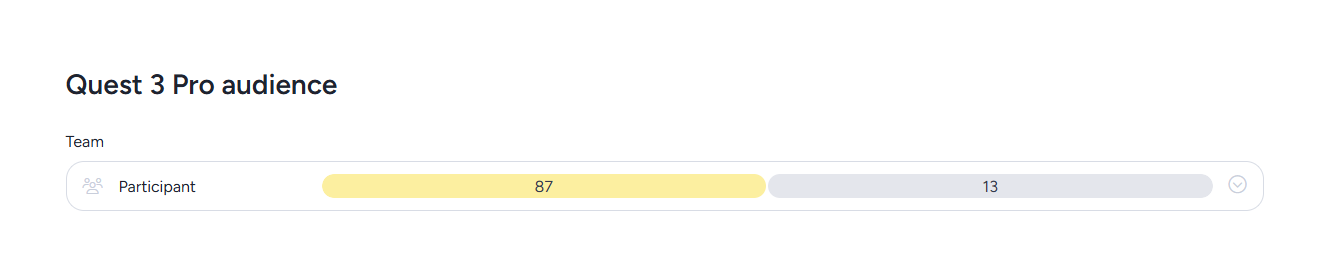
Displays the number of testers on each participant team (that has a target user number set) compared to the target number. Can be expanded to show team size over time compared to the goal during that time period.
Engagement by Phase
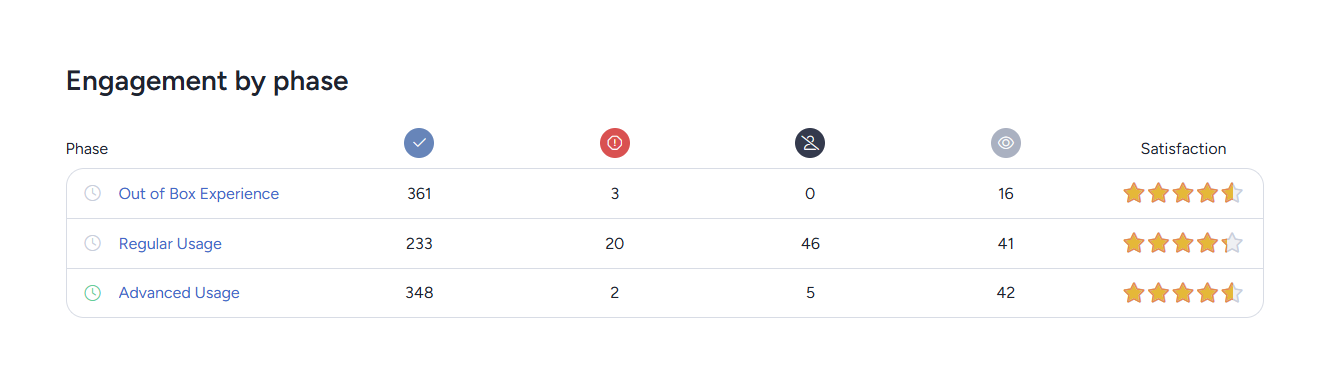
Shows a breakdown of overall feature status (completions, blocks, opt-outs, views) and satisfaction broken down by phase.
Ted’s Project Performance
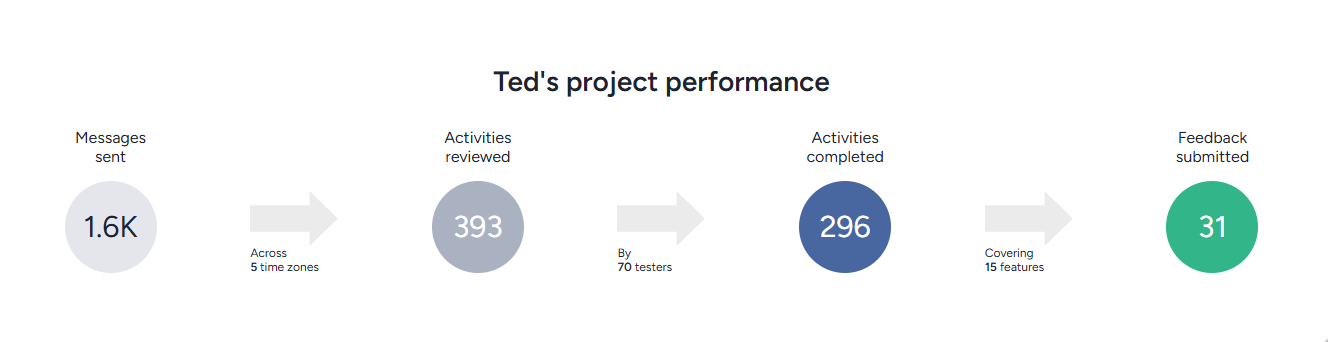
Displays Ted's email activity metrics for your project. Tracks the number of messages sent, including metrics for how many activities and feedback were viewed and completed by following links in Ted's emails.